- Contact us
- |
- About us
- |
- |
-
- Dashboard
- Personal information
- Organization
- Address book
- Sign in
- Don't have an account? Sign-up
EMI Shielding Effectiveness Measurement
Holland Shielding Systems measures, documents, and verifies the shielding performance of Faraday cages, shielded rooms, and other EMI and RFI shielding systems.
The shielding effectiveness measurement compares a reference signal level without the shielding barrier with the signal level measured through the shielding system. The difference between these measurements is expressed as shielding effectiveness in decibels (dB).
Measurements can be performed at multiple frequencies and locations to evaluate overall shielding performance and identify potential electromagnetic leakage or weak points.
How EMI Shielding Effectiveness Is Measured
A shielding effectiveness test compares the electromagnetic signal before and after the shielding barrier under documented measurement conditions.
Reference Measurement
The signal level is measured without the shielding barrier to establish a reference level for comparison.
Shielding Measurement
The measurement is repeated with the shielding system positioned between the transmitting and receiving equipment.
Calculate Effectiveness
The shielded signal level is subtracted from the reference level to determine the shielding effectiveness in dB.
Multiple Measurement Points
Measurements are repeated at selected locations and frequencies to identify local variations or potential weak points.
Reference Level - Shielded Level = Shielding Effectiveness
Example: +10 dB - (-80 dB) = 90 dB shielding effectiveness.
Typical EMI Shielding Measurement Locations
Shielding measurements can be performed at critical parts of a Faraday cage or shielded room where electromagnetic leakage is most likely to occur.
Shielded Doors
Door leaves, frames, hinges, and conductive contact surfaces are important measurement locations because discontinuities can affect shielding performance.
Ventilation Panels
Honeycomb ventilation panels and their conductive connections can be checked for electromagnetic leakage.
EMI Filters
Power and signal filters can be included in the measurement to verify shielding performance around filtered penetrations.
Walls and Panel Joints
Measurements can be performed on multiple walls and panel joints to identify local differences in shielding effectiveness.
Different Heights
Testing at different heights helps evaluate shielding performance across the complete enclosure.
Waveguides
Waveguides below cutoff can be tested as part of the complete shielding system to verify the achieved attenuation.
EMI Shielding Test Setup and Measurement Method
A documented setup helps make shielding effectiveness measurements traceable, repeatable, and suitable for comparison.
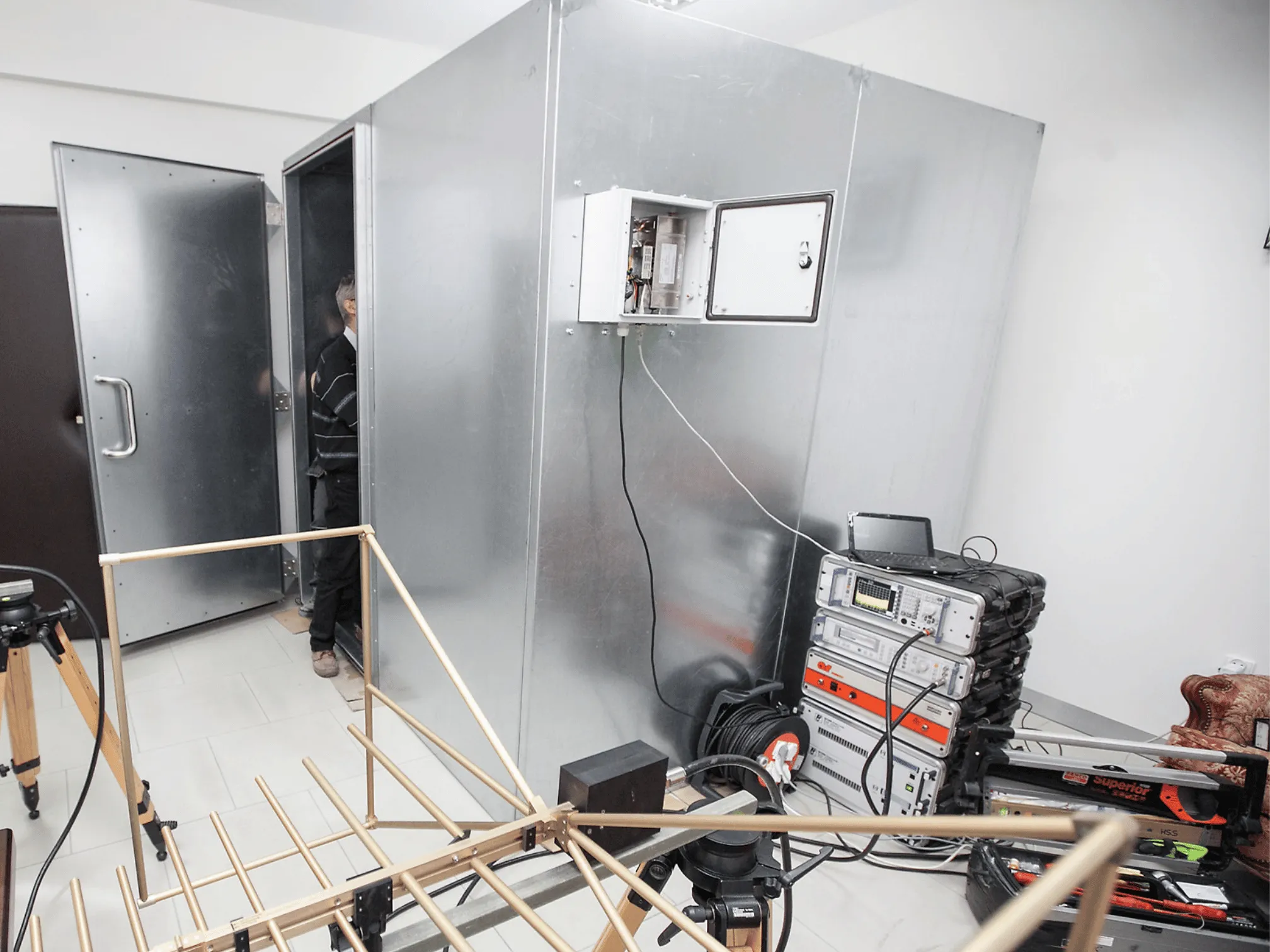
1. Documented Shielding Test Setup
The complete test setup is documented so the EMI shielding effectiveness measurement can be repeated under comparable conditions.
- Distance between the transmitting and receiving antennas
- Transmitter and receiver height
- Position inside or outside the shielded room
- Antenna orientation and polarization
- Cable dimensions and routing
- Selected measurement locations
Documenting these parameters helps reduce variations between reference and shielded measurements.
2. EMI Shielding Measurement Equipment
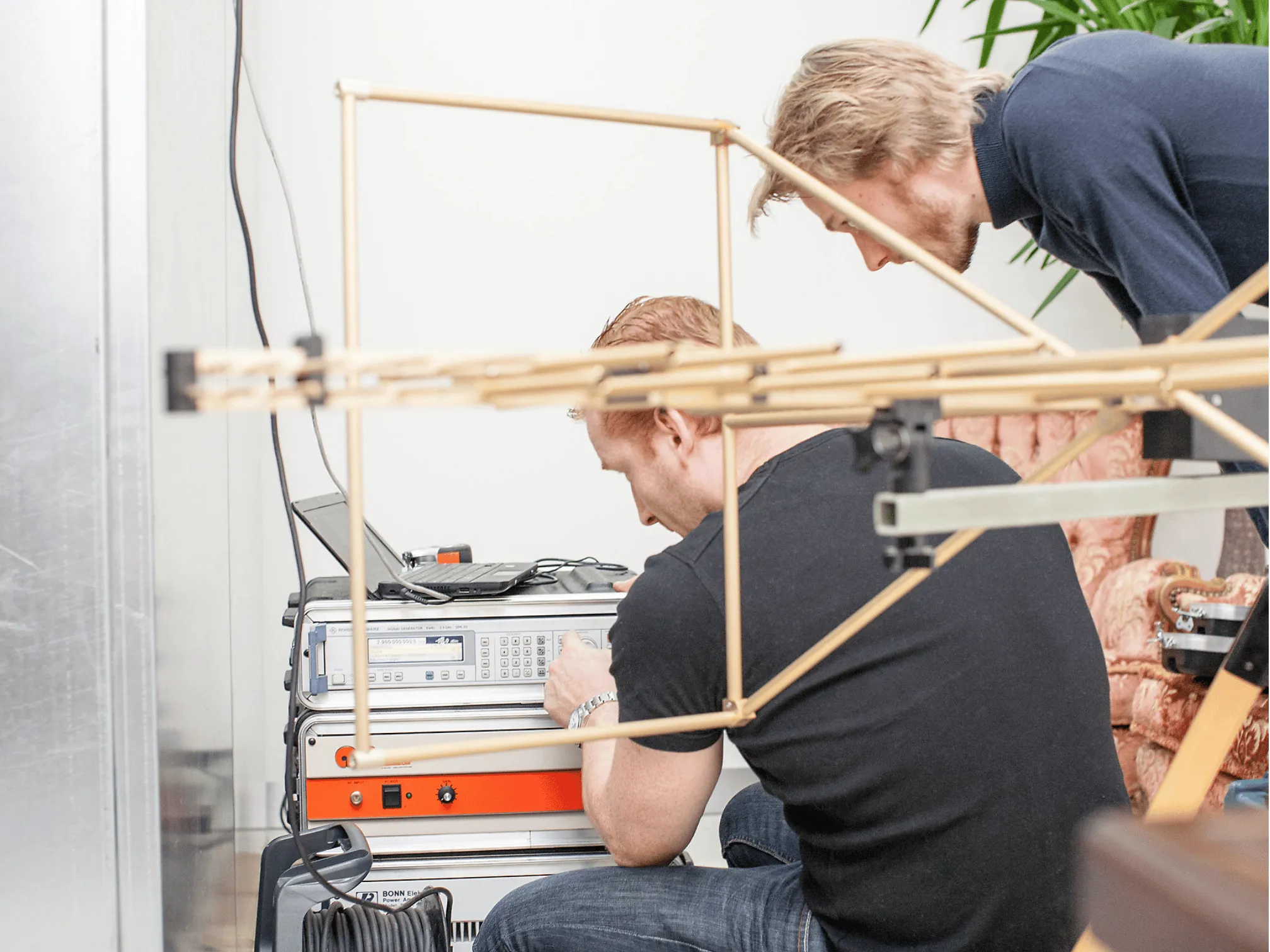
Typical equipment used during EMI shielding effectiveness measurements includes transmitting, receiving, amplification, analysis, and measurement equipment.
Transmit Antenna
Signal Generator
Power Amplifier
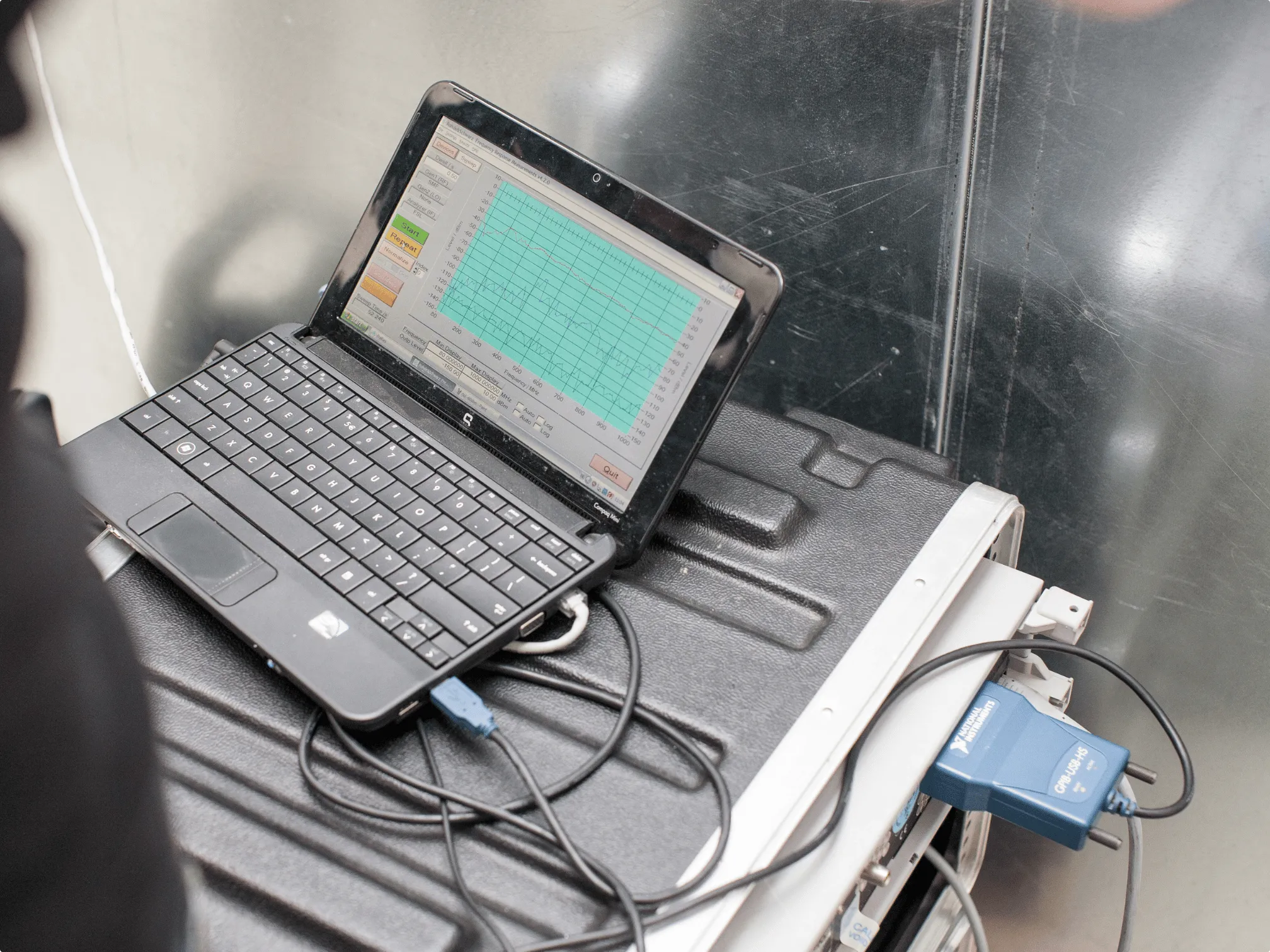
Measurement Software
Receive Antenna
Spectrum Analyzer
Coaxial Cables
3. Shielding Effectiveness Test Plan
Before testing, Holland Shielding Systems prepares a measurement plan based on the shielding system, required frequency range, and agreed performance criteria.
- Description of the test object
- Measurement equipment list
- Test setup
- Measurement procedure
- Frequency plan
- Measurement locations
- Acceptance criteria
The required acceptance criteria should be agreed with the customer before the shielding measurement begins.
How We Evaluate Shielding Performance
The measurement method can be configured around the shielding system, frequency range, project requirements, and agreed verification method.
Frequencies
Multiple frequencies can be measured within each selected frequency band to provide a more detailed view of shielding performance.
Moving-average
A moving average can be used to reduce the influence of isolated peaks and dips when interpreting measured data.
Documented results
The test setup, measurement results, observations, and conclusions can be documented in a shielding effectiveness test report.
Moving-average calculation
A moving average of three consecutive measured values can be used to provide a more stable interpretation of the measurement data.
| Measured values | Calculation | Result |
|---|---|---|
| 1, 2, 3 | Average | First moving-average value |
| 2, 3, 4 | Average | Second moving-average value |
| 3, 4, 5 | Average | Third moving-average value |
This method can smooth isolated peaks and dips without removing all measurement uncertainty.
Shielding effectiveness result comparison
Measurement graphs can compare recommended test frequencies, additional Holland Shielding Systems measurement frequencies, and the calculated moving average.
| Graph line | Meaning |
|---|---|
| Red line | Recommended measurement frequencies |
| Black line | Moving-average frequencies |
| Green line | IEEE recommended frequencies |
Measuring additional frequencies can provide a more detailed view of shielding effectiveness across the selected frequency range.
Please note: These values are measured under laboratory conditions. Results may vary in other situations; please read our Guarantee
EMI Shielding Effectiveness Test Report
Measurement results can be documented in a project-specific EMI shielding effectiveness test report.
Shielding Measurement Report Contents
- General project information
- Description of the shielded room or enclosure
- Documented test setup
- Measurement equipment
- Measurement locations
- Measured shielding effectiveness in dB
- Observations and conclusions
- Engineer identification and signature
The report can support quality control, project verification, and customer acceptance.
EMI Shielding Effectiveness Measurement FAQ
What Does Shielding Effectiveness in dB Mean?
Shielding effectiveness describes the reduction between the reference signal level and the signal level measured through the shielding system. The result is expressed in decibels (dB).
Which Parts of a Shielded Room Can Be Measured?
Measurements can be performed near shielded doors, ventilation panels, filters, waveguides, cable penetrations, walls, panel joints, ceilings, and other relevant construction details.
Can the EMI Shielding Measurement Method Be Adapted to the Project?
Yes. The frequency range, equipment, measurement locations, and acceptance criteria can be selected according to the shielding system and agreed customer requirements.
Does a Successful Shielding Measurement Guarantee Complete Electromagnetic Shielding?
No. Shielding performance depends on frequency, construction, installation, interfaces, and measurement conditions. The test verifies the achieved reduction within the agreed frequency range, test setup, and acceptance criteria.
Can Holland Shielding Systems Provide an EMI Shielding Test Report?
Yes. A measurement report can be provided with the documented setup, equipment, measured results, observations, and conclusions.
Need to Verify Your Shielding Performance?
Contact our specialists to discuss a suitable EMI shielding effectiveness test plan, acceptance measurement, or verification of an installed Faraday cage, shielded room, or other EMI/RFI shielding system.
Measurement results can be documented in a project-specific test report where required.

Worldwide leading manufacturer of EMC (electromagnetic compatibility), EMI (electromagnetic interference) and RFI (radio frequency interference) shielding solutions. Our EMC/EMI specialists will work together with you from the design phase through final production.
Useful links
Contact
3316 BP Dordrecht
The Netherlands
VAT: NL008884912B01
Tel: +31(0)78 - 204 90 00
Contact us
Opening hours: Monday until Friday - 8:30am-5:00pm CEST